Abba Seraphim’s letter to the Foreign Secretary
The Right Hon. William Hague,
House of Commons,
London, SW1A 0AA
Dear Mr. Hague,
I am writing on behalf of the Law & Parliamentary Committee of the British Orthodox Church to express concern about aspects of the United Kingdom’s current policy towards the civil war in Syria.
Whilst we share the concerns of all peaceful people for the plight of ordinary citizens caught up in the fighting, and join in condemning the brutal atrocities committed by both groups of combatants, we nevertheless feel that the British government’s endorsement and support of the so-called Free Syrian Army is a grave error.
Atrocities have been committed by all sides in this conflict and the Free Syrian Army is no more innocent of these than any other of the combatants. In September the respected international NGO, Human Rights Watch reported that armed opposition groups have subjected detainees to ill-treatment and torture and committed more than a dozen extrajudicial or summary executions in Aleppo, Latakia, and Idlib. Although Opposition leaders told Human Rights Watch that they will respect human rights and that they have taken measures to curb the abuses, Human Rights Watch expressed serious concern about statements by some opposition leaders. When confronted with evidence of extrajudicial executions, three opposition leaders stated that those who killed deserved to be killed, and that only the worst criminals were being executed.
The only support which the United Kingdom government should be offering is in strictly humanitarian aid, mediated through recognised independent agencies. In mid-August, when Britain announced its intention to send £5 million ($8 million) in aid directly to the Free Syrian Army it sent an ‘unbalanced’ message to the parties in Syria, because it placed insufficient blame or conditions on the regime’s opponents.
We have particular concern for the plight of the Christian minority, which appears already to have suffered unduly. These Christian communities have survived since Apostolic times and have flourished alongside other faiths harmoniously for generations. We see the dire situation of Christians in Iraq as a warning of what could happen in Syria. Statements by the British government during this conflict have not given adequate attention to the plight of Christians in Syria. We are especially concerned that areas where there was formerly a substantial Christian population have been significantly reduced in numbers. In the central city of Homs, where there has always been a large Christian population, there was heavy fighting in which several churches and Christian centres were destroyed or damaged. It is reported that some 60,000 Christians have been expelled by the Free Syrian Army’s ‘al-Farouq Brigade’. This pattern of forced eviction, or of using some of the prominent Christians as hostages or ‘human-shields’ has been repeated throughout the towns and villages of Syria and is well documented by the international aid organisation, the Barnabas Fund.
On 16 September, Lebanon’s Daily Star contained reports of fierce fighting in the compound of the Armenian Orthodox Church in Aleppo’s Midan District, whose walls had been pierced by rocket-propelled grenades. The Syriac Orthodox Archbishop of Aleppo, Mar Gregorios Yohanna Ibrahim, told Reuters that hundreds of Christian families had fled in recent weeks as rebels and soldiers battle for control of the country’s biggest city. “In its modern history Aleppo has not seen such critical and painful times as the last few weeks. Christians have been attacked and kidnapped in monstrous ways and their relatives have paid big sums for their release,” he said. In the central city of Homs, which saw the heaviest bloodshed earlier this year, he said several churches and Christian centres had been damaged in the fighting.
The Church has avoided partisan politics yet backed the regime’s policy of religious co-operation and inter-faith dialogue. It would be unfair to see them as collaborators, rather that they worked to build bridges and show mutual love and respect. The Melkite Patriarch of Antioch, Gregory III expressed this well when he said, “The Church is not for or against the regime,” he added, “but it is a community that wants to give a testimony of love and wants to save Syria.” He also warned “Reconciliation is the only way possible: otherwise Syria heads towards death … In the conflict that continues in Syria, chaos prevails and there are no appropriate answers. No one has them, neither the government, nor the opposition, nor the international community. We are in the dark and, in this situation, faith is the answer and reconciliation is our proposal.” At its meeting at Atchaneh in Lebanon(10-14 September) the Holy Synod of the Syrian Orthodox Church resolved, “The Holy Synod feels the responsibility of all parties to stop violence, the language of weapons, killings and violations at all levels. They urge everyone to promote the dialogue of peace, which is basic for all reforms and solutions of the current crises.”
Whilst it is fundamental that the only solution is one made by Syrians, it is unrealistic to exclude the current Syrian regime from these talks. The fact that they have survived the violence of the past eighteen months and still have the support of the military, as well as the merchant and professional classes of the main cities, demonstrates that they are not without significant popular backing. In February the Syrian government held a referendum on a new constitution leading to greater democracy and multi-party government but it was boycoted by the opposition and rejected by the Western powers. There is a peaceful opposition in Syrian society but its voice is being rejected by the violent armed opposition backed by external interests and Islamic extremists, who seek to control or destroy Syria for their own ends.
We urge the British government:
(1) to work towards achieving a cease-fire by both government and opposition forces
(2) to continue to work for dialogue and reconciliation in Syria involving both government and opposition forces
(3) to respect the sovereignty of Syria and the principle of non-interference in their domestic affairs.
(4) to cease offering any assistance whatsoever to opposition forces
(5) to continue to offer humanitarian aid to all who have suffered in the present conflict
(6) to ensure the safeguarding of all Christian minorities in Syria and that they have a voice in the process of reconciliation which must proceed an end to conflict.
Yours sincerely,
+ Seraphim
Abba Seraphim
The State of Ecumenism fifty years on from Vatican II
On the evening of Thursday 11 October, Fr. Peter Farrington and Subdeacon Daniel Malyon represented the British Orthodox Church at an event commemorating the 50th anniversary of the Second Vatican Council. This was held at Heythrop College and organised by the Society for Ecumenical Studies. The event involved talks by the Most Rev’d Kevin McDonald, former Roman Catholic Archbishop of Southwark, and the Rev’d Dr James Hawkey, a Minor Canon of Westminster Abbey, on the state of ecumenism in the fifty years following the Second Vatican Council of the Roman Catholic Church.
Archbishop Kevin Mcdonald looked at his experiences working with the Secretariat for Promoting Christian Unity (later renamed The Pontifical Council for Promoting Christian Unity). He covered key parts of the development of Rome’s Ecumenical relationships with the Oriental Orthodox, Eastern Orthodox and Anglicans as well as a number of protestant groups. He then went on to discuss the Roman Catholic policy towards other religions, especially Judaism. The talk was well received due to its in-depth detail and the relevance of his experience in the field.
This was followed by Rev’d Dr James Hawkey, who responded to the talk by highlighting the gains and challenges to be faced in the future of the movement. This talk also looked at the social challenges we are facing as Christian communities, such as the varying approaches to secularism and the vastly changing modern society.
The two talks were followed by observations from Methodist and United reformed Church ministers and some very well thought out questions from the audience which tackled the issues of the role of women in Roman Catholicism, inter-faith dialogue and grass-roots responses to the Ecumenical movement. These reminded us again of the many issues facing all Christian communities in the modern world.
Altogether, the night was extremely educational and informative for all there, from those who have been involved in ecumenical relations for decades to those who are new to the concept. It also demonstrated the willingness of the Christian Community to come together and work to understand each other and our shared Christian faith without compromising on their own values and practices, which is the key value of the movement itself.
Orthodox Mission begins in Windsor
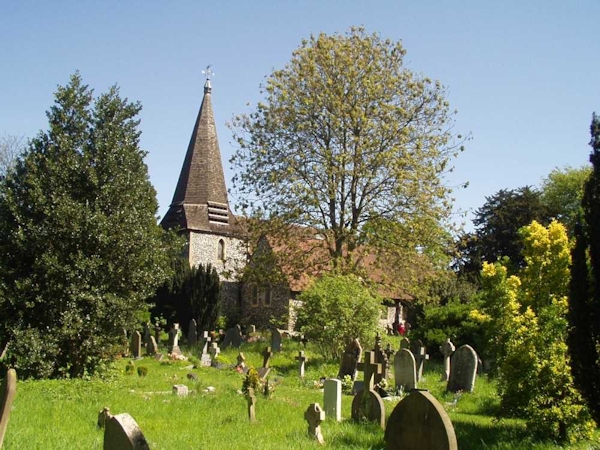
The first service of Orthodox prayer at the Orthodox Mission of St Andrew, Windsor, went very well indeed, far exceeding what had been hoped for. Father Peter had prepared to pray with one person he had been visiting for some months, but as the prayers from the Agpeya, or Coptic Daily Office, began there were eight people from a variety of backgrounds who had come together to begin this new service. And a further eight people had wanted to be present but were unable to do so for various reasons.
The Church of St Andrew is a beautiful and ancient place of prayer and the mission gathered in the smaller of three chapels. During the prayers Father Peter preached on the Gospel of the Miraculous Catch of Fish, and spoke of the need for perseverance in the Christian life and in the service of God.
After this encouraging start the next service of prayer will take place on Monday, November 12th, 6:30 pm at St Andrew’s, Mill Lane, Clewer, Windsor.
This will be a regular monthly event which will develop according to the will of God.
For further information, or for any enquiries, please contact Father Peter at [email protected]
New Barnabas Fund Library inaugurated
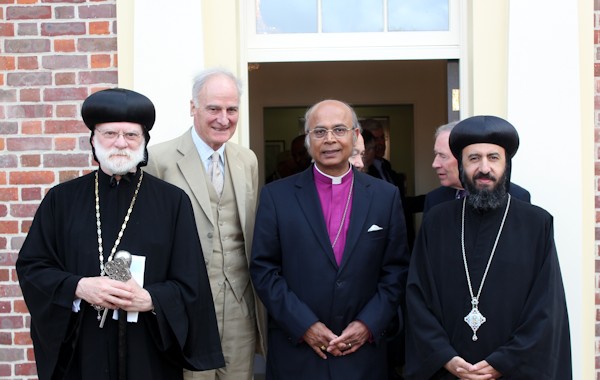
Abba Seraphim was among the guests who attended the opening of the new Barnabas Fund library at Pewsey, Wiltshire, on 12 September. The library is housed in a purpose-built, state of the art building designed by the distinguished classical architect, Quinlan Terry, who was among those present. The library is a specialist collection on Islam and Christian-Islamic relations and contains some 50,000 volumes as well as periodicals and electronic resources. Housed on three floors, it includes open shelf reference books, a delightful Reading Room as well as reserve stacks, with a capacity for 10,000 volumes. The Barnabas Fund is also planning to extend its residential capacity to facilitate research conferences and extended research by scholars and specialists.
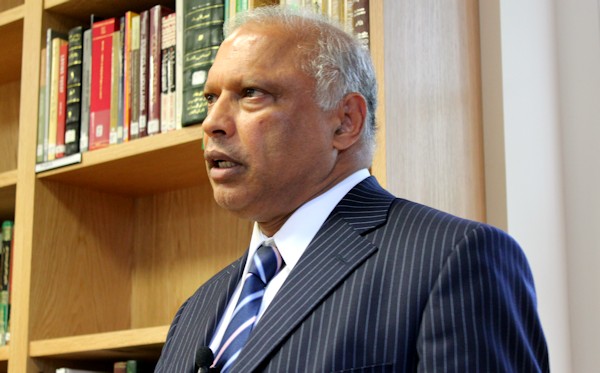
Following an introductory speech, detailing the scope of the library, by Father Patrick Sookhdeo, the Fund’s International Director, and prayers & scriptural readings marking the library’s inauguration, the guests were entertained to a delightful lunch. After this Father Patrick briefed them on current priorities of the Fund, whilst Caroline Kershaw and Mark Green spoke specifically about the projects undertaken by the Fund to support Christian communities around the world.
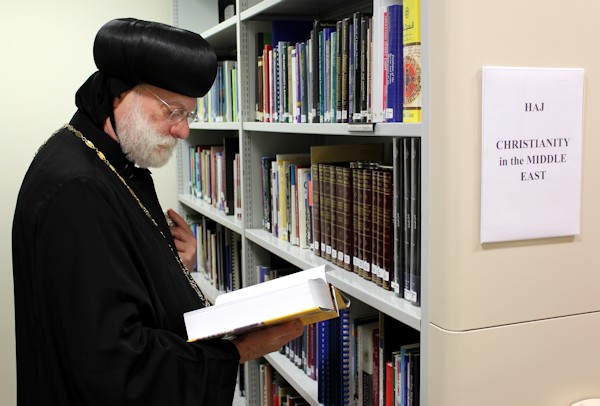
Abba Seraphim, a noted bibliophile, spoke enthusiastically of the great service the Fund would now be able to offer to scholars of Islamic-Christian relations. “For years the Barnabas Fund has offered support and practical comfort to beleaguered Christian communities by reminding Christians in the West of the fact that being a Christian is often a dangerous conviction, requiring profound commitment and bravery. This practical support for the neglected and persecuted, done out of deep fraternal love and a desire to follow the Lord’s command to support our weaker brethren, has now expanded to meet the intellectual and philosophical challenges of the dialogue between faiths. The Barnabas Fund has always been rooted in a profound understanding of Islam and to engage Muslims with a sound appreciation of the tenets of their faith, leading to improved relations with Christians and mutual respect.”
Abba Seraphim visits Eritrean Church in Birmingham
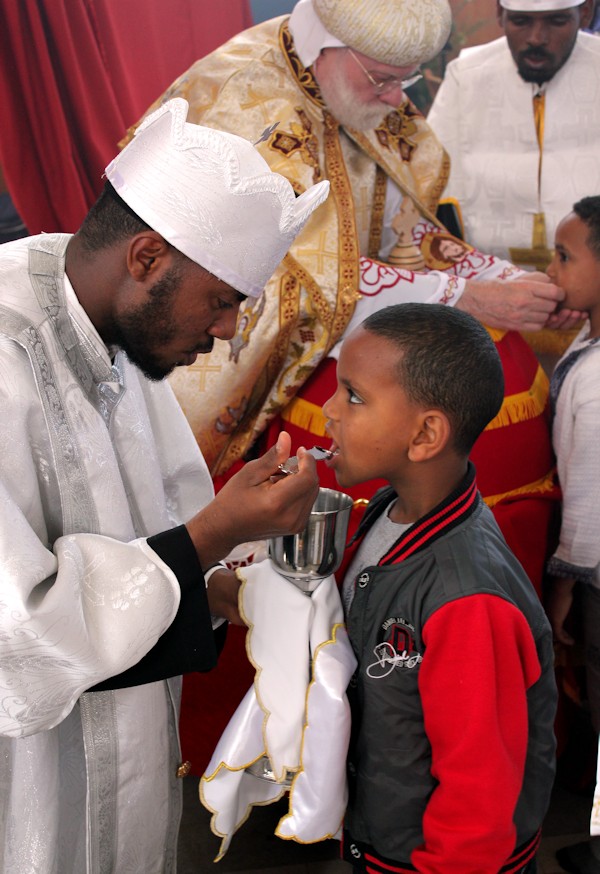
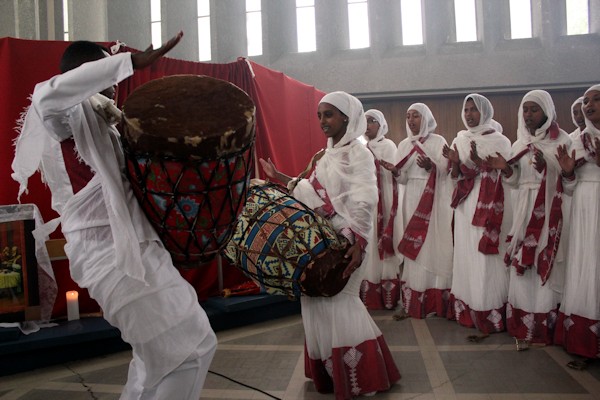
On 8 September Abba Seraphim celebrated the Divine Liturgy at St. George’s Church, Bridge Street, Newtown, Birmingham, at the invitation of Father Mulebrhan, the newly ordained priest for the local Eritrean Orthodox community within the Diocese of Europe, under His Grace Bishop Makarios. Assisting him were Father Mulebrhan and Father Yonas Tesheme from Sheffield as well as a number of deacons. Abba Seraphim preached on the Gospel of the day (Matthew XI: 1-20) to a large and devout congregation. Following the service and traditional religious songs and dances, Abba Seraphim spoke about his long association with the Eritrean Orthodox Church in the UK and answered questions from the congregation about the situation of the Eritrean diaspora following the uncanonical removal of His Holiness Abune Antonios, the Eritrean Patriarch, in 2006. This congregation remains loyal to the Patriarch, whom it continues to pray for in the diptychs. Thanks were also expressed to Abba Seraphim for his unwavering support for the loyalist Eritrean clergy and faithful.