First new bishops consecrated by Pope Tawadros
On Sunday, 10 March, at St. Mark’s Cathedral in Cairo, His Holiness Pope Tawadros II, assisted by members of the Holy Synod, elevated seven priests to the episcopate. The chief priority in this first batch of new bishops was the provision of bishops for areas of Coptic population and the re-oganisation of dioceses in Egypt. Father Epiphanius el-Makary was consecrated Bishop-Abbot of the ancient Monastery of St. Makarios in Wadi el-Natr’un, under the name of Bishop Epiphanios. For a number of years this monastery, under its spiritual guide, Father Matthew the Poor, had pursued a rather distinctive form of monasticism, but this appointment of a new Bishop-Abbot marks the final stage of the process of reintegrating it into the Coptic mainstream. Fr Makar el-Baramousy was consecrated as Bishop of 10 Ramadan city (population 450,000+) and its vicinity in Sharqiya Governorate, east of the Delta, under the name Bishop Makar. Father Saleeb el-Samueli was consecrated as Bishop Samuel, Bishop of Tamouh, El-Badrashein, El Hawamdiah (all south of Giza) & affiliate jurisdictions and Father Yulius Ava-Mina was consecrated as a general bishop in Cairo.
When Metropolitan Domadios of Giza (the ancient Memphis), died in September 2011 he had ruled the diocese for some forty-eight years, during which the population had expanded enormously. Although for the latter part of his ministry, Metropolitan Domadios was confined to a wheel chair as the result of a stroke, his diocese not only expanded with a huge church building programme but it was also an outstanding example of both spiritual and charitable activities. It was now decided to divide this huge diocese into four smaller smaller dioceses. Fr Yu’annis el-Suriani became Bishop Yuhanna, Bishop of North Giza; Father Zosima el-Antony was consecrated as Bishop Zosima of Etfeeh (Aphroditopolis) & El-Saff. Father Zakaria el-Suriani, was consecrated Bishop of 6 October City and Uossim, and chose to take the name of Bishop Domadios in honour of the late Metropolitan.
Bishop Theodosius, who had been consecrated in 2009 as a General Bishop to assist Metropolitan Domadios, was now appointed as Bishop of Central Giza. Two other long-standing General Bishops were also now appointed as diocesan bishops: Bishop Boutros, head of Aghapy TV, who was originally ordained a chorepiscopos in 1979 and a General Bishop in 1985, serving as an Auxiliary in the diocese of Ismailia 1985-1998, was enthroned as Bishop of Shebin al-Qanater (an area of northern metropolitan Cairo, comprising 36 villages in the Governorate of Qalyubia); and Bishop Daniel, who was consecrated as a General Bishop in 1991 and served as Assistant to the diocese of Gherge 1991-93, and looked after the south Cairo suburbs of Mahdi & Kotsika since 1963, has now become diocesan bishop of the same area.
An important appointment for the lands of the diaspora was the provision of a Bishop for Canada. Bishop Mina, who had been ordained as a General Bishop in 2009, with responsibility for Old Cairo since 2010, was been appointed as Bishop of Mississauga, Vancouver and Western Canada.
Abba Seraphim welcomes statement by Patriarch John X of Antioch
Abba Seraphim has welcomed the recent comments by His Beatitude Patriarch John X of Antioch in his Encyclical Letter, which speaks of the need to work towards full sacramental unity between the two families of Orthodox Churches. “It is the most encouraging step in this long dialogue for several years and we must hope that other Patriarchs will respond with the same clarity and conviction as Patriarch John”, said Abba Seraphim. “The significant agreements made during the official dialogue between the Eastern & Oriental Orthodox Churches between 1985-1993 had seemed so full of promise but, sadly, over the past twenty years there has been little or no movement to build on these. In the past, the two Patriarchates of Antioch have been in the forefront of co-operation and practical implementation of the agreements reached. It is heartening to see that Patriarch John has made this a priority. At a time when the political situation in Syria is so dark and destructive, the reaching out in love between the two Orthodox families is a ray of light and hope.”
The section of Patriarch John’s extensive Encyclical which addresses this is given below:
“Towards a Full Sacramental Unity of the Christians:
We, as Antiochians, are aware of the painful wound inflicted on the body of Christ by the schism between the believers. This has led the Antiochian Church to participate actively for decades in every dialogue to remove the obstacles which block the way to restoring the unity of the Christian world. We will always be faithful to the policy of my predecessors. I insist on the importance of maintaining the absolute respect between the Churches ignoring any arrogance, anathematizing, and schismatization. I am deeply convinced that Orthodoxy; which is the basis of every interaction between us and other Churches, is a unifying factor not a divisive one. I am also convinced that adhering to it is the right way. With love and humility, we strengthen the common factors that bind us all together. There will undoubtedly be differences, not in essentials, and this a source of propitious diversity. This shall be considered a richness to us, and not a deviation of our adherence to Christ.
Therefore, we hope to accomplish all steps towards a full sacramental unity with our brethren in the Eastern non-Chalcedonian Churches, based on what we have agreed upon in Chambesy as a positive result of a long and extensive dialogue. If we realize this, we should be able to show that we have offered a living example of the credibility of our endeavors to achieve unity and to witness to our loyalty to the Lord. On this occasion, we also affirm that we will continue all dialogues now taking place between the different Eastern and Western Churches, seeking to show our unlimited readiness to show the face of the bride, that is the Church. In this respect, we should affirm the importance of the living witness which we as Christians should show by living the love we carry to the whole world in the name of Jesus Christ. We call for consultation among ourselves as Christian Churches, about the different issues raised by the modem world, emphasizing the issues that unite us and constitute our common denominators. These common denominators can be offered to the man of today as a consolation from the Lord.”
First British Orthodox Liturgy in Windsor
This is a warm invitation to two opportunities to worship with us in Windsor at our Orthodox Mission of St Andrew this week.
On Monday 11th March we are meeting to pray a service of Orthodox Evening Prayer in the English language. We begin our prayers at 6:30 pm at St Andrew’s Church of England, Mill Lane, Clewer, Windsor. Father Peter Farrington will lead the prayers from the Orthodox Daily Office of the Coptic Orthodox tradition in the English language. After the service of prayer there will be time for conversation and refreshments.
On Saturday 16th March, this coming Saturday, we are meeting to celebrate the Orthodox Liturgy in the English language for the first time at St Andrew’s, Mill Lane, Clewer, Windsor. Our morning of worship will begin at 9:30 am with the Raising of Incense, and the Liturgy itself will begin at 10:00 am. His Eminence Metropolitan Seraphim will celebrate the Liturgy assisted by Father Peter Farrington. There will be an opportunity for conversation and refreshments after the Liturgy.
You are most warmly welcome to attend either or both of these services. If you know of others who may be interested in participating in our Orthodox worship then do please pass this message on to them.
Seminar on Glastonbury Abbey – a great success
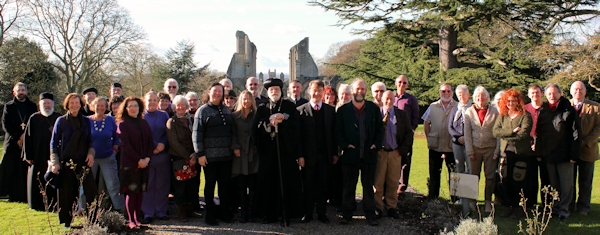
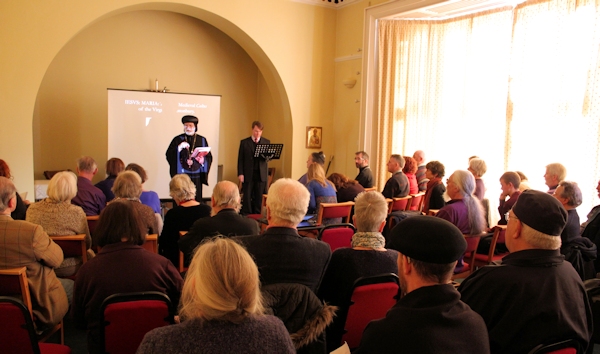
On 2 February Abba Seraphim chaired a well attended day seminar on “Glastonbury Abbey – Influence and Legacy” organised by the British Orthodox Church. It was held at the Abbey House in Glastonbury, across the lawns of which the impressive ruins of the mediaeval abbey stand. It was a crisp and sunny day and both the abbey and the town were bathed in sunlight. It was universally agreed that all four lectures were both informative and engaging and during the intervals in the proceedings, there was a relaxed and sociable interchange between lecturers and ‘seminarians’.
Dr. Cheryl Green opened proceedings by talking about the Glastonbury Abbey Excavation Archive Project, which has been analysing and reinterpreting the records of previous excavations made between 1908-1979. Her enthusiasm was matched by her helpful plans and matching slides as she explained some of the exciting discoveries and possibilities opened up by the project. Professor Michelle Brown, who engaged her audience with her brilliant knowledge and command of Anglo-Saxon manuscripts, showed how the wider cultural context impinged on Glastonbury Abbey and introduced documents known to have emanated or been kept at the Abbey before its Dissolution. Dr. Tim Hopkinson-Ball, whose previous studies on Glastonbury have dealt with its more recent history, showed a facile command of its mediaeval history and concentrated on the pre-eminence of the Marian cultus at Glastonbury. Dr. Adam Stout, who has previously dealt with Glastonbury’s little known 18th century history traced the development of the traditions concerning St. Joseph of Arimathea and how they were used as religious propaganda by both Catholic and Protestants. The last two speakers have both made notable contributions and original research to much neglected aspects of Glastonbury’s rich history.
It is hoped to publish some of the papers in the Glastonbury Review.
Among British Orthodox clergy present were Father Simon Smyth, Father Martin Lee (Sidmouth) and Deacon John Stuart (Exeter).
Following the conclusion of the seminar, Father Thomas Cook, a priest of the Western Rite Vicariate of the Russian Orthodox Church Outside of Russia, led Vespers at St. Margaret’s Church in Glastonbury.
Annual St. Felix Lecture falls victim to snow
The Annual Lecture & Service at St. Felix, Babingley, which traditionally conclude the Week of Prayer for Christian Unity, which was scheduled for Saturday, 19, January, has had to be cancelled as a result of the sudden cold spell, bringing with it heavy snow and serious disruption on the roads. Nicolas Crampton, founder of Eastern Christian Links, was due to speak on “Nicaea Revisited.” Abba Seraphim said that this was the first occasion in 12 years that the annual lecture had not been held. He stated that the lecture would be re-scheduled for a later date, but he would arrange this for a time when it would not be a hostage to the weather. “We have just installed new heaters at St Felix, so we could have managed with the low outside temperatures, but I am anxious not to put people at risk of accidents or being unable to return home safely and I do agree with the advice not to make unnecessary journeys if they can be avoided.” For the same reason, there will be no Sunday service at St. Felix on 20 January.