Abba Seraphim talks about Britain’s only assassinated Prime Minister
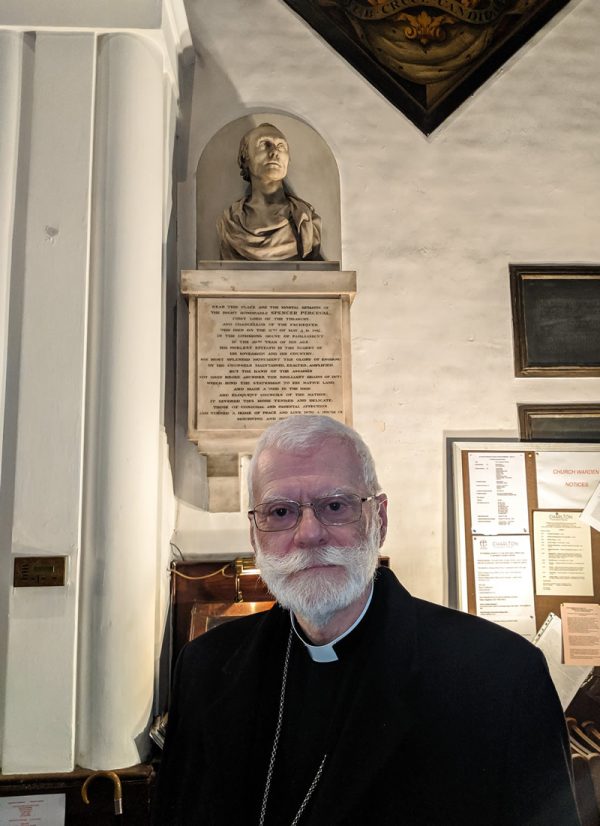
On Saturday, 26 October Abba Seraphim gave a lecture at Charlton House, Greenwich at the Annual General Meeting of the Charlton Society on the life of Spencer Perceval (1762-1812), Britain’s First Lord of the Treasury (Prime Minister) & Chancellor of the Exchequer (1809-1812), who was assassinated in the lobby of the House of Commons by a former bankrupt trader who had a grievance against the government.
Spencer Perceval’s father and grandfather, the Earls of Egmont, had leased Charlton House during the eighteenth century and Spencer was brought up there, before living nearby with his brother when he courted and eventually married Jane Wilson, daughter of Charlton’s Lord of the Manor. Following his murder he was buried in the Egmont family vault at Saint Luke’s Church, where his son Henry Perceval served as Rector in 1826, and an impressive bust by Sir Francis Chantrey (1781-1841) is a notable monument in Charlton Church. In talking about his historical links with Charlton and his religious and political convictions, Abba Seraphim also mentioned that his son, Spencer Perceval, junior (1795-1859) was one of the Restored XII Apostles of the nineteenth century Catholic Apostolic Church.
At the end of the meeting, the Rector of Charlton, opened St. Luke’s Church to enable those present at the lecture to visit Spencer Perceval’s monument.
New issue of The Glastonbury Review published
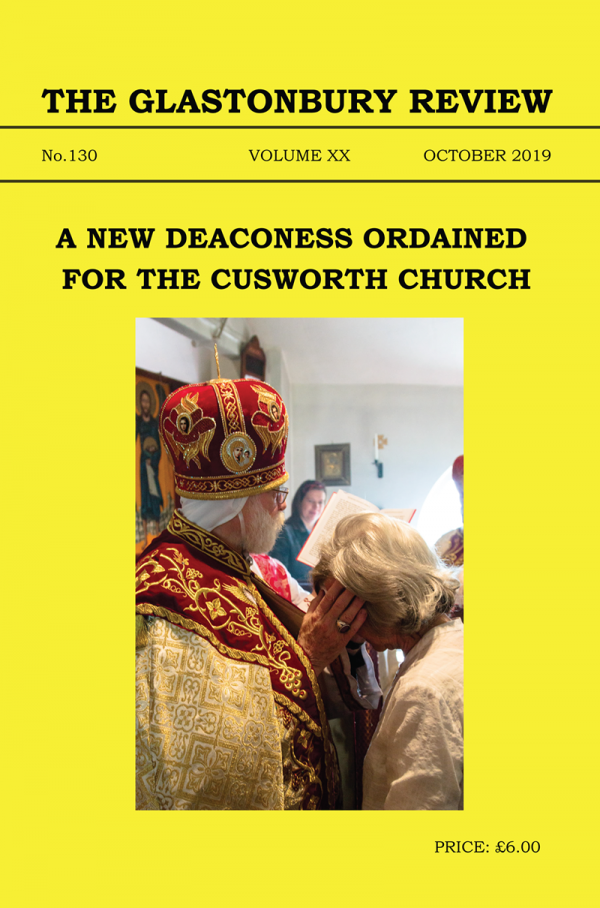
Issue No. 130 (October 2019) of the Glastonbury Review has just been published. This issue is 122 pages. The front and back covers carry pictures taken at the ordination of a new deaconess for the Cusworth Church, which is reported in detail along with key items of news since the last issue. The “Oriental Orthodox Church News” section contains a report of the funeral of the late Armenian Patriarch Mesrob II of Constantinople; a report on a renewed attempt to dethrone Patriarch Antonios of Eritrea and news of the current ethic and nationalist violence in Ethiopia.
Among the articles are the first part of a series on “The Enlighteners of Britain” by Hieromonk John Ives; “What about Astrology?” by Dr. David Brattstone; “Beginning with Church History” and”A Travesty of Pretended Canonicity” both by Abba Seraphim and a previously unpublisdhed article on “The Early History of the Patriarchs of Antioch” written by Abba Seraphim when he was a 19-year old Protodeacon.
The ‘Book Review’ section includes Abba Seraphim’s latest book Exiles from Eden, the sequel to his “Flesh of Our Brethren”; a rare translation of an edition of the Byzantine Rite published for the Russian ‘Living Church’; a second volume of research on Western Rites of Syriac-Malankara Orthodox Churches; a new biography of the late Metropolitan Anthony Bloom by Avril Pyman; the new British Orthodox Ordinal and J. W. Klein’s scholarly The Mental Universe of the English Nonjurors. This issue concludes with an obituary of Patriarch Mesrob II of Constantinople.
Copies can be obtained directly from www.Lulu.com
A new Deaconess Ordained for the Cusworth Church
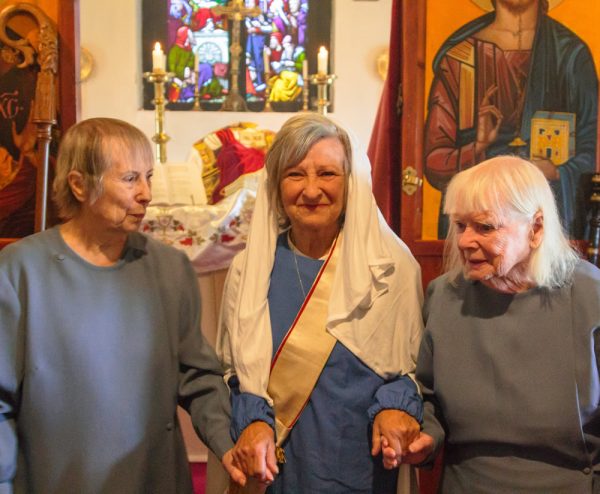
On 4 June 1989 Metropolitan Seraphim ordained two deaconesses for the church at Cusworth, which was the first ordination of that ministry for over 30 years, as the only two deaconesses remaining from those earlier days were then both in their seventies and had not been involved in active ministry for many years. Sisters Elizabeth (Beresford) and Sarah (Metcalfe) – who are the two ordained in 1989 – have served faithfully at the Cusworth church for the past thirty years, but with advancing age and various health issues they have not been as active of late as previously, although they have both remained active and faithful members of the congregation at Cusworth.
On 6 October 2019 Abba Seraphim ordained Elaine Dale, who has been a member of the Cusworth congregation for nineteen years and who has been a visitor of the sick and elderly for many years, as a deaconess, giving her the name of Sister Helena in honour of the Emperor Constantine’s mother, Saint Helena (c.246-330), whom two mediaeval chronicles (Henry of Huntingdon’s Historia Angloum and Geoffrey of Monmouth’s Historia Regum Britanniae) claimed was a daughter of the King of Britain, Coel Hen of Colchester, who allied with Helena’s husband, the Caesar Constantius Chlorus to avoid more war between the Britons and Rome.
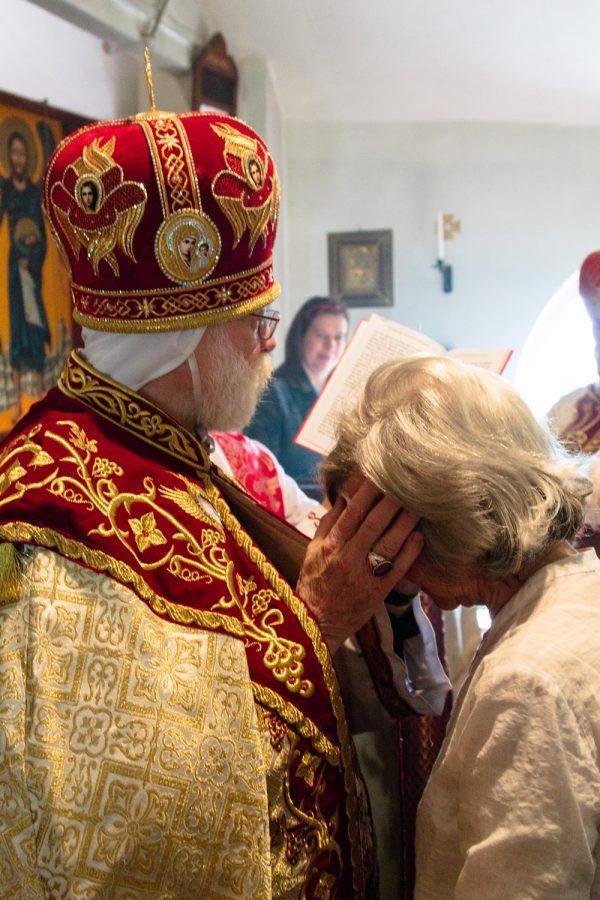
Following the Kiss of Peace in the divine Liturgy, Elaine was presented to Abba Seraphim by Deaconesses Elizabeth and Sarah.
A second cause for celebration
On 7 October Abba David, Bishop of Priddy, reached his 80th birthday and in anticipation of this Abba Seraphim hosted a thanksgiving dinner at The Boat Inn at Sprotbrough following the Raising of Evening Incense at Cusworth on Saturday, 5 October, which was attended by Abba David, Abba James, Elaine Dale and Vladimir Roze. Thanksgiving prayers were offered during the Divine Liturgy at Cusworth the following morning.
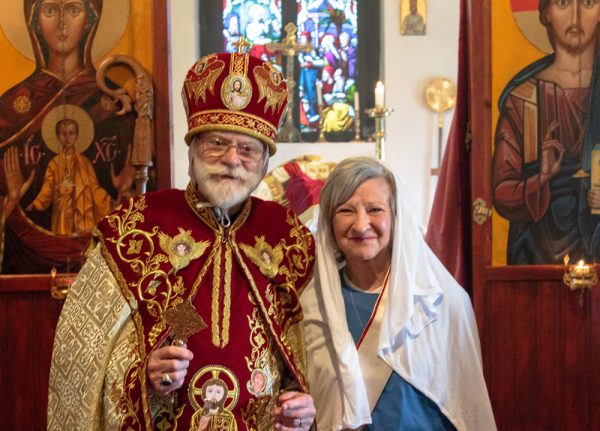
Among the several visitors who attended the Divine Liturgy to mark this double celebration was Mgr. Douglas Lewins, Archbishop of the Old Roman Catholic Church, who is a most welcome friend and guest of the church at Cusworth.
Abba Seraphim suffers a fall and a fracture
On Wednesday, 25 September, whilst travelling, Abba Seraphim accidentally tripped over, with the result that he suffered cuts on his hands and also hurt his right arm, which became very painful. The next morning he attended the Urgent Care department at his local hospital so that they could take an x-ray of his shoulder. Unfortunately, it revealed a proximal fracture at the neck of the humerus. Such fractures don’t normally require surgery because the broken ends usually stay close together, which makes it easier for the humerus to heal on its own. However, the doctors require him to wear a Shoulder Sling, to restrict his arm’s movement in order to stabilise his shoulder. Healing times vary greatly depending on the type of fracture, but he will probably need to wear the sling for about six weeks. Abba Seraphim expresses his gratitude for all the many kind messages he has received in response to his accident, as well as the assurance of prayers for his timely and complete recovery. He trusts that he may continue to fulfil all his liturgical commitments, whilst Abba James’s role as his coadjutor will prove to be a significant and practical support in his current predicament.
The annual Llanthony Pilgrimage
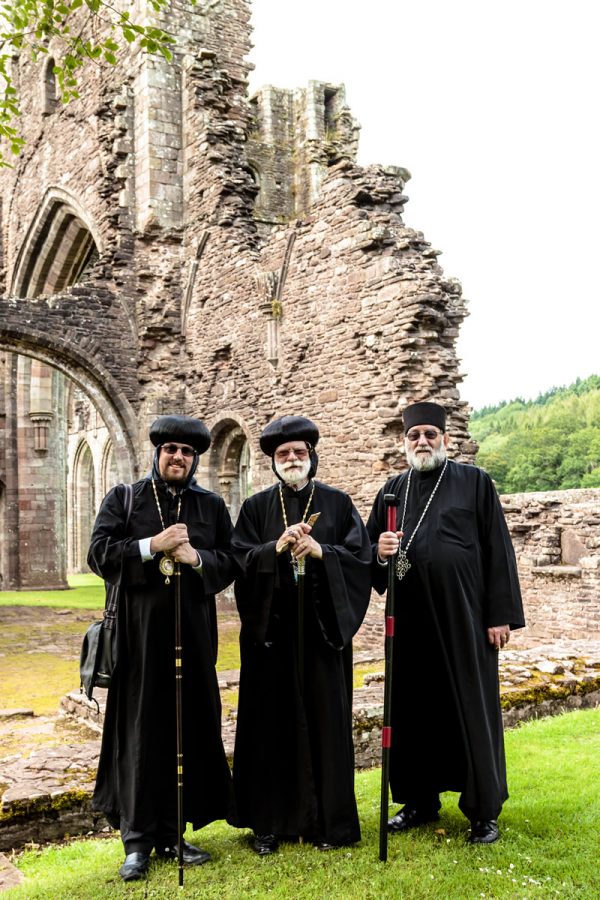
On Saturday, 17 August, Abba Seraphim and Abba James, accompanied by Archdeacon Antony Holland, attended the annual Llanthony Pilgrimage organised by the Father Ignatius Memorial Trust. The last time that Abba Seraphim attended the Pilgrimage was forty-four years ago, when – as a priest – he accompanied his predecessor, Mar Georgius (1905-1979), Metropolitan of Glastonbury. On that occasion, 30 August 1975, the preacher then was the late Father Brocard Sewell (1912-2000), a Carmelite friar.
Upon arrival, Abba Seraphim and his companions, were greeted by Mr. Hugh Allen, a long-standing trustee and the author of the scholarly history of “New Llanthony Abbey” (2016). The 2019 Pilgrimage began with a Sung Eucharist at St. David’s Church. Llanthony, which stands on the site of a sixth-century cell belonging to St. David, on which the infirmary of the twelfth century Augustinian Llanthony Priory was later constructed. The celebrant was Father Philip Wyn Davies of Tregaron. Among the pilgrims were Canon Mark Soady and three brothers of the Holywell Community, a newly established male monastic community following the Rule of St. Benedict, based in Abergavenny.
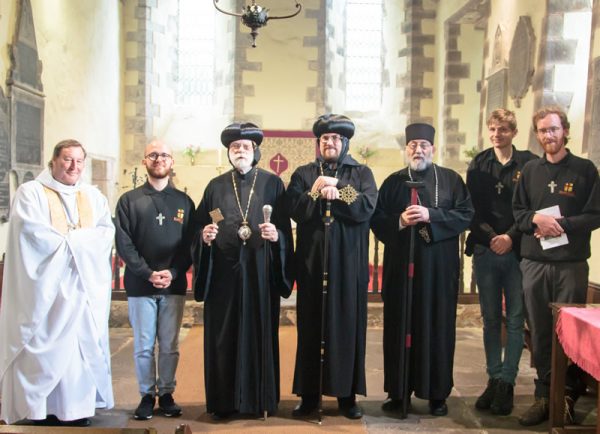
Following this, the pilgrims gathered for lunch in and around the ruins of Llanthony Priory, set in the outstandingly beautiful Black Mountains. After lunch some of the pilgrims travelled on foot to Capel-y-Ffin, some five miles away. At 3.30 pm Evensong was held in the tiny late-eighteenth century church of St. Mary, Capel-y-Fin, where Canon Simon Griffiths, Precentor at Truro Cathedral, preached an impressive sermon on the mission and witness of Father Ignatius. After this, the pilgrims processed up the hill to the site of Father Ignatius’s monastery and the ruins of the church, where he was buried in 1908. During the procession the Litany of Our Lady was sung in Latin and prayers were also said at the Wayside Calvary and at a Statue of the Mother of God situated on the terrace in front of the former monastery.
Father Ignatius was a committed traditionist who actively condemned heresies publicly sanctioned among his contemporary clergy: notably Canon Wilberforce denying our Lord’s Resurrection on Easter Day, which had been approved by Archbishop Frederick Temple; the denial of our Lord’s Virgin Birth by the Vicar of Yardley (C.E. Beeby); and Dean Fremantle of Ripon – whom Father Ignatius called “the Prince of Infidels” – who denied our Lord’s Ascension and stated that “we are not to pretend that the Scriptures are absolutely perfect in any part” and that our Lord Himself did not “pretend to an absolute knowledge of God.” Although we live in very different times, the drift away from traditional Christian belief is tragically still prevalent. Commenting on the Pilgrimage, Abba Seraphim said he was deeply touched by the warmth and spirit of fellowship which he encountered throughout the day, and that among the pilgrims – who largely comprised Anglo-Catholics, Roman Catholics and Orthodox – there was a shared commitment to traditional Christianity, which was demonstrated by a genuine œcumenical spirit underlying their veneration for the Mother of God and commemoration of Father Ignatius and his testimony.