Ordination of another Subdeacon
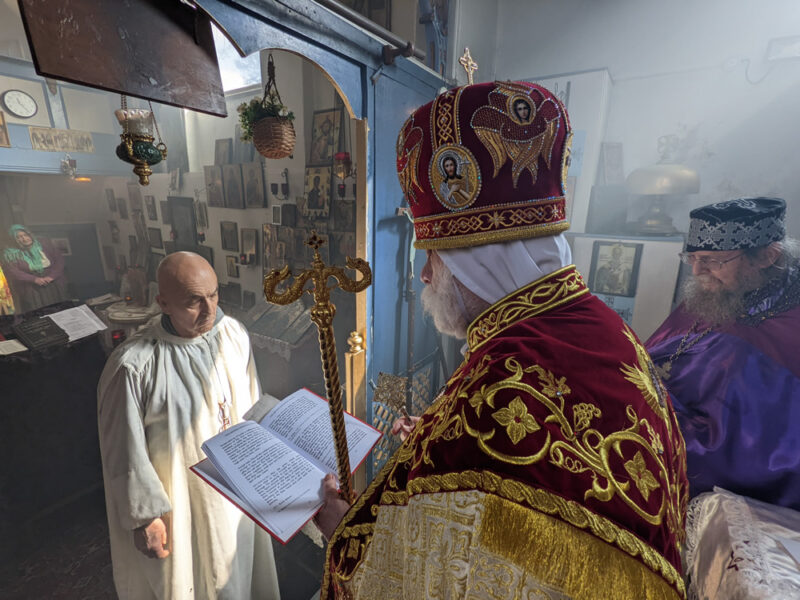
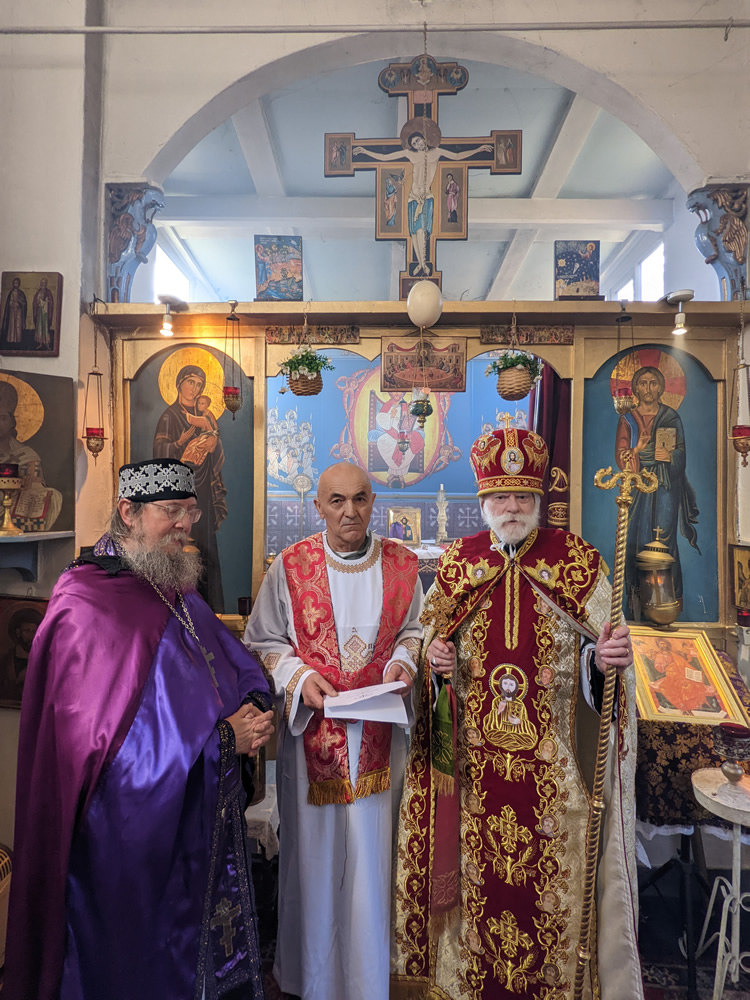
Abba Seraphim, Metropolitan of Glastonbury, accompanied by his Coadjutor, Abba James, travelled to the Church of Christ the Saviour in Bournemouth to celebrate the Liturgy for the second Sunday in Lent, 20 March 2022, also assisted by Father John Ives, the British Orthodox Parish priest for Bournemouth, during which Abba Seraphim ordained Yuriy Kot to the Order of Subdeacon, who has now adopted the religious name of Georgy.
Following the Liturgy Abba Seraphim also met with the church’s neighbour, Susanna Riddell of Woodend Road, who has recently negotiated with one of her other neighbours to have his trees cut down which have long proved serious problems for her as well as for the Church of Christ the Saviour.
Afterwards Abba James drove Abba Seraphim to Portsmouth to administer the eucharistic sacrament to Archdeacon Antony Holland, whose current health problems do not enable him to travel to the Bournemouth Church.
PRAYERFUL SUPPORT FOR UKRAINIAN ORTHODOX
The British Orthodox Church is praying regularly for the welfare of the Ukrainians, who are currently suffering regular aggression from the Russians. We never support the invasion and killing of a population of any independent state by its neighbours, who seek to resume control of it.
Historic connection of the Ukraine with Russia
Anciently Ukraine belonged to the Polish–Lithuanian Commonwealth until late in 1793, when after the Russo-Turkish War (1768–1774) the Empress Catherine the Great (1762-1796) and her immediate successors encouraged German immigration into Ukraine and especially into the Crimea, to reduce the previously dominant Turkish population and the Ukraine then became part of the Russian Empire. Much later, following the February 1917 revolution in Russia with the end of Tsarist rule and the establishment of four socialist republics on the territory of the former Empire: the Russian and Transcaucasian Soviet Federated Socialist Republics and the Ukrainian and Belorussian Soviet Socialist Republics. Following when the Ukraine became a People’s Republic the All-Ukrainian Orthodox Church Sobor (Council) was formed in 1917 at the Saint Sophia Cathedral in Kiev and consisted of representatives of the clergy and the laity from all parts of Ukraine. The council was determined to put an end to the church’s dependence on Moscow and summoned the All-Ukrainian Church Sobor at the beginning of 1918. The council also devoted special attention to the Ukrainianisation of the parishes and the liturgy. The first liturgy in Ukrainian was conducted in Kiev at Saint Nicholas’s Military Cathedral on 9 May 1919. Through the efforts of the council, the Ukrainian Orthodox Church shortly after Ukraine’s newly found independence declared itself to be autocephalous on 5 May 1920 in Kiev and in 1921 a Sobor was summoned, and it established the hierarchy of the Ukrainian Autocephalous Orthodox Church (UAOC).
Patriarchs of Kiev
In 1942 Mstyslav Skrypnyk (1898 –1993) was consecrated as Bishop of Pereiaslav by the Ukrainian Orthodox Church, who in 1949 then served as Bishop of the Ukrainian Orthodox Church in America and later in Europe before being elected at the age of 93 as the first Patriarch of Kiev & All Ukraine of the Ukrainian Autokephalous Orthodox Church – Kieven Patriarchate (UAOC-KP) and was enthroned as Patriarch Mstyslav I on 6 November 1991 in St. Sophia Cathedral in Kiev. After the death of Patriarch Mstyslav in 1993, the UAOC-KP Church was headed by Patriarch Volodymyr Romaniuk (1925-1995). In July 1995, upon the death of Volodymyr, Philaret Denysenko, who was Metropolitan of Kiev of the Russian Orthodox Church (1966–1992) was then elected head of the UAOC-KP but with the collapse of the Soviet Union in 1991, Ukraine became an independent state, formalised with a referendum in December 1991. In 1961, Philaret served in the mission of the Russian Orthodox Church to the Patriarch of Alexandria and in January 1962 he was elected vicar Bishop of the Leningrad Eparchy and, in February, was consecrated bishop in Leningrad by Metropolitan Pimen Izvekov (later Patriarch of Moscow: 1971-1990). Philaret was appointed to several diplomatic missions of the Russian Orthodox Church and from 1962-1964 served as Russian Orthodox Bishop of Vienna & Austria. In 1964 Philaret returned to Moscow as the Bishop of Dmitrov and rector of the Moscow Theological Academy and Seminary. In 1968 he became Metropolitan of Kiev & Galicia. On 3 May 1990, Patriarch Pimen of Moscow died and, the same day, Philaret became the locum tenens of the Russian Orthodox Church. But he was not elected Patriarch of Moscow. Retrospectively, in 2019, Philaret declared “it was not by chance that I was not elected. The Lord prepared me for Ukraine” On 27 October 1990, in a ceremony at St. Sophia Cathedral in Kiev, the newly elected Patriarch of Moscow, Alexei II Ridiger (1990-2008) handed to Metropolitan Philaret a tomos granting “independence in self government” (the tomos did not use either of the words “autonomy” or “autocephaly”) to Metropolitan Philaret, and enthroned Philaret, heretofore “Metropolitan of Kiev”, as “Metropolitan of Kiev and All-Ukraine”.
Shortly thereafter, the Russian Orthodox Church was unable to prevent the creation of what it viewed as a “schismatic church” in independent Ukraine which helped to organize a rival synod which was held in Kharkiv in May 1992. These bishops elected a bishop of the Russian Orthodox Church, Bishop Volodymyr (Sabodan) as Metropolitan of Kiev, and received recognition from Moscow as being the Ukrainian Orthodox Church of the Moscow Patriarchate (UOC-MP). Philaret was suspended on 27 May 1992 by the Ukrainian Orthodox Church (Moscow Patriarchate). The bishops loyal to Metropolitan Philaret and a similar group from the Ukrainian Autocephalous Orthodox Church (another recently revived church in Ukraine) organised a unifying Sobor which was held on 25-26 June 1992, named the Ukrainian Orthodox Church – Kiev Patriarchate (UAOC-KP). Philaret was defrocked by the Russian Orthodox Church on 11 July 1992. The UAOC-KP was not recognised by other Orthodox churches and was considered schismatic. Philaret was then anathemised by the Russian Orthodox Church in 1997.
Ukrainian Autokephaly granted by the Œcumenical Patriarchate
In January 1992, shortly after Ukraine gained its independence from the Soviet Union (USSR), some of Ukraine’s presidents, notably President Petro Poroshenko met with the Œcumenical Patriarch Bartholomeos on 16 June 2016, Ukraine’s parliament, asked the Œcumenical Patriarch Bartholomeos I of Constantinople for autokephaly for the Orthodox Church of Ukraine and thus independence from the Russian Orthodox Church and signed an agreement on cooperation and interaction between Kiev and the Patriarchate of Constantinople to pave the way for the establishment of an independent Ukrainian church distinct from the Moscow Patriarchate. This decision led the Holy Synod of the Russian Orthodox Church to break communion with the Œcumenical Patriarchate on 15 October 2018, which marked the beginning of the 2018 Moscow–Constantinople schism.
The present Ukrainian Primate is Epiphanius Dumenko, who was born on 3 February 1979 in Vovkove, Berezivka Raion, and was later elected Bishop of Vyshhorod, vicar of the Kiev diocese on 21 October 200 and consecrated on 15 November 2009. On 28 June 2013, he was raised to the rank of Metropolitan of Pereyaslav & Bila Tserkva, in the former original Ukrainian Orthodox Church (Kiev Patriarchate) from 2013-2018. On 15 December 2018, at the unification council held in the Cathedral of St. Sophia, he was elected Metropolitan of Kiev & All Ukraine, the Primate of the Autocephalous Orthodox Church of Ukraine. On 5 January 2019, Bartholomeos I, the Œcumenical Patriarch of Constantinople, signed a tomos that officially recognised and established the Orthodox Church of Ukraine and granted it autokephaly (self-governorship) and Epiphanius was enthroned on 3 February 2019, in St. Sophia’s Cathedral, Kiev.
Abba Seraphim recently received a very friendly email from Yurii Yurchyk, Ukrainian Orthodox Bishop of Donetsk & Mariupol, who wrote to Abba Seraphim to wish him “good health during this difficult time of the pandemic and blessings over this new year 2022.” He was born in Ukraine in 1973, ordained a priest just over twenty years ago and until 2005 he was a parish priest in the City of Donetsk and then consecrated as Ukrainian Orthodox Bishop of Donetsk (now under Russian occupation). He told Abba Seraphim that he was “interested in the traditions of the Oriental Churches for many years” and asked Abba Seraphim to send him the text of our church’s liturgy in English. When Abba Seraphim looked online to find out more about him, he read the following: “According to the Congregation of Mary Immaculate Queen (CMRI) website “Bishop Yurchyk was accepted into the Catholic faith by Bishop Mark Pivarunas, CMRI, of the USA. The CMRI is not in communion with Rome and rejects the Second Vatican Council. The website of the Ukrainian Orthodox Church-Moscow Patriarchate (UOC-MP) repeated the story on 18 November 2002, and Internet sites also covered it. In his statement of 19 November 2002, posted on the site of the UAOC-KP, Bishop Yurii denied the story. He called the publication of the UOC-MP “libel, targeted at discrediting not only my title of bishop, but also the whole Kievan Patriarchate and the whole church.” “Concerning my contacts with heterodox churches in the USA, they really took place. However, there was no transfer to Catholicism on my part whatsoever… As the bishop of Donetsk, I maintain such contacts… and believe that this is a normal and civilized phenomenon. Regarding my ‘repentance’ of ‘schism’ or my acceptance of Catholic doctrines, this is inaccurate information. I was and remain a hierarch of the Ukrainian Orthodox Church-Kievan Patriarchate,” reads the statement of Bishop Yurii Yurchyk.
Apart from the complex issues of canonicity, the schism is inspired by a fundamental political conflict arising from Russia’s 2014 annexation of the Crimea and its military intervention in Ukraine, as well as Ukraine’s expressed wish to enter into an alliance with the European Union and NATO. The British Orthodox Church, however, supports the Œcumenical Patriarch and the newly independent Ukrainian Orthodox Church and was very happy to publish in The Glastonbury Review No.131 (March 2020) “Simple Thoughts – Answers on The Ukrainian Issue” by Hieromonk Nikitas from the Athonite Monastery of the Pantokrator.
Triple Anniversaries
Today is Abba Seraphim’s 74th birthday, but today’s date is also the 51st anniversary of his ordination as a priest and tomorrow, being the anniversary of his cousin & predecessor, Mar Georgius’s death in 1979 (who was also 74), it will be his 43rd anniversary as Metropolitan of Glastonbury. He will be celebrating today’s Liturgy at St. Thomas’ Church, Charlton, after which Abba James and their Greek Orthodox friend, Makis Panopoulis will accompany them to dinner this evening at Sky Garden, at Bank in the City, which is a top floor restaurant of a skyscraper: https://skygarden.london/
Death of Abune Antonios, Patriarch of Eritrea
Abune Antonios, the third Patriarch of the Eritrean Orthodox Tewahedo Church died on 9 February 2022 at Asmara, Eritrea, at the age of 94
Abune Antonios was born on 12 July 1927 in the town of Hembrti, in the province of Hamasien. He was ordained priest in 1942, and later elected as Abbot of the Debre Tsege Abuna Endrias monastery in 1955. When Eritrea gained its independence from Ethiopia in 1993 the Eritrean Orthodox Tewahedo Church was granted autocephaly by Pope Shenouda III, Patriarch of Alexandria of the Coptic Orthodox Church, and Antonios was one of the five abbots of Eritrean monasteries who went to Egypt to be ordained as bishops so that their church would have its own Holy Synod. He was consecrated as Bishop Antonios of Hamasien-Asmara on the Feast of Pentecost, 19 June 1994, in Saint Mark’s Coptic Orthodox Cathedral, Cairo, by Pope Shenouda III, on the same day that Abba Seraphim was ordained as a Metropolitan by Pope Shenouda.
The first Patriarch of Eritrea was Abune Phillipos (1901-2002), who was appointed by Pope Shenouda on 7 May 1999 but was succeeded by Abune Yacob. The pontificate of Abune Yacob (1924-2003) as second Patriarch of Eritrea was very brief, as he died not long after his enthronement, and he was then succeeded by Abune Antonios as the third Patriarch of Eritrea. Abune Antonios was elected on 5 March 2004, and enthroned as the third Patriarch of the Orthodox Tewahedo Church of Eritrea on 24 April 2004. Pope Shenouda III presided at the ceremony in Asmara, together with the Holy Synod of the Eritrean Orthodox Church and a Coptic Orthodox Church delegation.
He was illegally and forcefully deposed by the Eritrean government in 2006, and was placed under house arrest thereafter.
In August 2005, Abune Antonios, the Patriarch of the Eritrean Orthodox Tewahedo Church, was confined to a strictly ceremonial röle. In a letter dated 13 January 2006 Abune Antonios was informed that following several sessions of the church’s Holy Synod, he had been formally deposed. In a written response that was widely published, the Patriarch rejected the grounds of his dismissal, questioned the legitimacy of the synod, and excommunicated two signatories of the 13 January 2006 letter, including Yoftahe Dimetros, whom the Patriarch identified as being responsible for the church’s recent upheavals. Patriarch Antonios also appealed his case to the Council of the Monasteries of the Eritrean Orthodox Church and to the Coptic Orthodox Church of Alexandria. Abune Antonios was deposed by the Eritrean Holy Synod supposedly under pressure from the Eritrean government led by President Isais Afwerki. The religious freedom situation in Eritrea under the régime of President Afwerki was extremely grave, with an estimated 2,000 to 3,000 religious prisoners and reports of torture and other inhumane treatment of religious prisoners. The government dominated the internal affairs of the Orthodox Church of Eritrea, which was the country’s largest Christian denomination, and also suppressed Muslim religious activities and groups.
In 2006 Abune Antonios was placed under house arrest and strict surveillance and held without charge and on 27 May 2007 the government wrongly deposed him in violation of the church’s constitution and canons and on the same day, in the early hours of the morning Abune Antonios was forcibly removed from his residence and transported to an undisclosed location, where he was kept under house arrest, but he protested government interference in his church’s affairs. Abuna Antonios was replaced by Bishop Dioskoros of Mendefera as the 4th Patriarch of the church, who eventually died on 21 December 2015. Charges were brought against him by Yeftehe Dimetros, a layman appointed by the government as administrator of the Orthodox Church.
Among accusations brought against the Patriarch, were his reluctance to excommunicate 3,000 members of the Medhane Alem, an Orthodox Sunday School movement, and his demands that the government should release imprisoned Christians accused of treason. He was allowed to officiate at church services, but prohibited from having any administrative röle in church affairs.
He continued to be held under duress, with state agents ensuring that he could not leave the premises. There has never been an opportunity for him to question and challenge this illegal detention in a court of law. He was detained arbitrarily and without charge or trial, solely at the whim of the Eritrean President and ruling clique in government. He was being held virtually incommunicado, and was deprived of all contact with clergy and friends.
Since 2007 Abune Antonios had been considered by the USA to be a religious prisoner of conscience. His removal at the behest of the Eritrean government was denounced by the other Oriental Orthodox Churches, who refused to recognize Abune Dioskoros as Patriarch of Eritrea. In July 2019, in an unprecedented move, bishops of the Holy Synod of the Eritrean Orthodox Tewahedo Church excommunicated Abune Antonios for heresy. The letter from five of the six most senior Eritrean bishops declared that “His name should never be mentioned and remembered and those who do so will be punished severely.” Although the Patriarch was expelled from being a member of the church, the bishops promised he could still live in a church building. The president of the Standing Conference of Oriental Orthodox Churches condemned his excommunication.
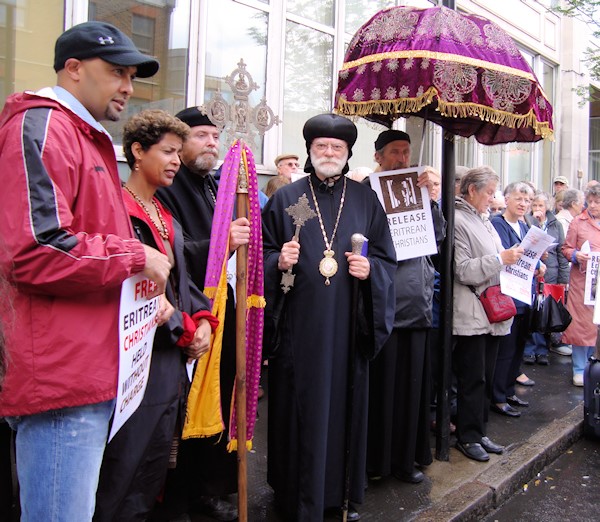
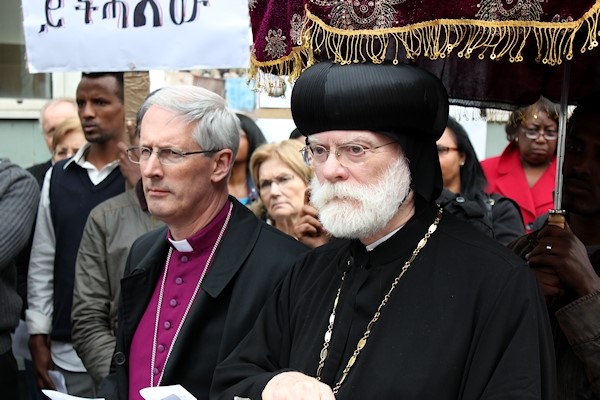
Following his deposition Abba Seraphim frequently joined an annual Protest outside the Eritrean Embassy in Islington, London.
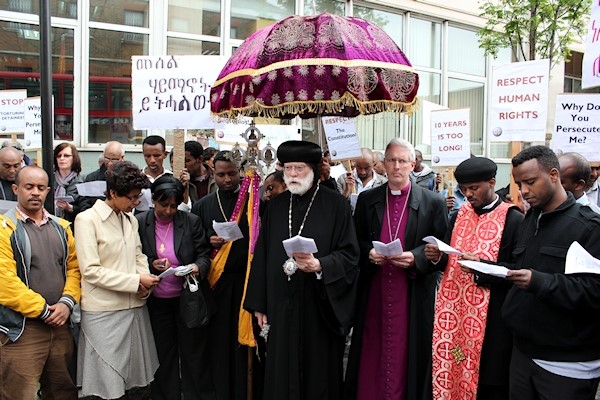
The protesters took up their position on the pavement opposite the embassy and represented a wide rank of Christian denominations as well as of several human rights groups (Christian Solidarity Worldwide, Release International, Release Eritrea, Church on Chains, Human Rights Concern Eritrea) who came together to pray for the persecuted Christians of Eritrea and their government. A large number of the banners portrayed His Holiness Abune Antonios, the imprisoned Patriarch of Eritrea. Abba Seraphim was joined by the Anglican Bishop of Southwark (The Right Rev’d Christopher Chessum), Father Yonas Tesheme (Sheffield) and Deacon Joannes Gebrehiwet (Manchester) with a number of other deacons representing the Eritrean Orthodox Diocese of Europe. Speakers and Prayers were led by Abba Seraphim, Andy Dipper (Release International), Dr. Berhane Ashmelesh (Release Eritrea), David Turner (Church in Chains), Elsa Chyrum (Human Rights Concern Eritrea), Selam Kidane (Release Eritrea), Dr. Khataza Gondwe (CSW). At the end of the protest a letter was signed on behalf of the whole group by Abba Seraphim and Bishop Christopher and was delivered to the Eritrean Ambassador.
Orthodox celebration of the Queen’s Platinum Jubilee
The British Orthodox Church is resolutely Monarchist and as 6th February 2022 is the seventieth anniversary of the death of King George VI and the accession of his daughter as Queen Elizabeth II, the Divine Liturgy for this Sunday will include special prayers for Queen Elizabeth’s Platinum Jubilee and the commemoration of King George VI. Our queen’s great-great-grandmother, Queen Victoria was previously our longest reigning sovereign, but only reigned for sixty-three years (1837-1901) whilst the longest reigning European monarch was King Louis XIV of France, who reigned for seventy two years (1643-1715). Metropolitan Abba Seraphim will commemorate our Queen’s Jubilee by celebrating the Divine Liturgy at the Church of St. Mary & St. Felix at Babingley, which is in the fields of the royal Sandringham estate in Norfolk.