Abba Seraphim welcomes the Founder of Coptic Orphans
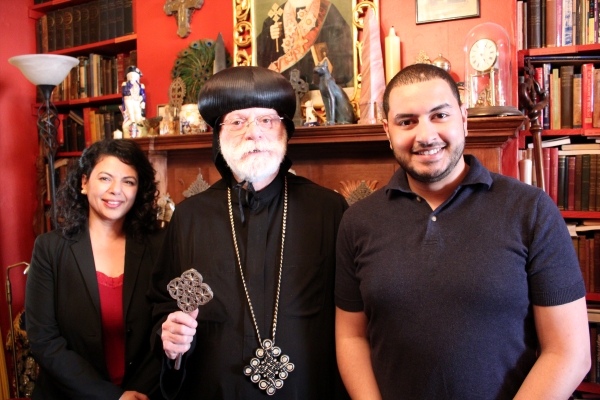
On 23 April, Abba Seraphim welcomed for tea at the Church Secretariat in Charlton, Nermien Riad of Washington DC, the Founder and Executive Director of Coptic Orphans. She was accompanied by Jean-Paul Markos, manager of Coptic Orphans’ UK office in London. While visiting London they came to speak with Abba Seraphim about the amazing way their ministry has been blessed and grown over the more than a quarter century since it was founded. Abba Seraphim, who lost his father at the age of four, shared with them his own experience of being supported through his education by committed Christians and spoke of the importance of empowerment of young people through education and spoke appreciatively of the important work being done by Coptic Orphans.
Ethiopian Orthodox martyred for their Faith
News of the brutal murder of Ethiopian migrant workers in Libya by the so-called Islamic state follows on from their relentless attacks on vulnerable Christians throughout the Middle East and North Africa. It comes as the Archbishop of Canterbury visits Egypt on an eirenic visit to offer his condolences to His Holiness Pope Tawadros for the similar slaughter earlier this year of twenty-one poor Coptic workers. Archbishop Welby also met with the Grand Imam of Al-Azhar, Sheikh Mohamed Ahmed el-Tayeb. His description of the so-called Islamic state as “deeply evil” echoes the response of both Christian and Islamic leaders.
Writing to His Grace Abune Antonios, the diocesan bishop of the Ethiopian Orthodox Church in Great Britain, Abba Seraphim offered his deepest sympathy at the shocking news of the brutal murder of Ethiopian Orthodox Christians at the hands of extremists in Libya. Coming so soon after the murder of the Coptic workers, he stated that he shared their grief and anguish.
“These are terrible times for our Oriental Orthodox churches as we commemorate the centenary of the Armenian Genocide and Syriac Sayfo, to find that we now face the demonic destruction of Orthodox churches and cruel treatment of Christians across the Middle East and Africa at the hands of Daesh. We draw comfort from the knowledge that those who perish at the hands of these vicious murderers remain faithful unto death, have received the crown of life, and now dwell for ever in the presence of their Saviour. We also mourn the tragic loss of life of those recently drowned in the Mediterranean, among whom were Christians from Ethiopia and Eritrea.”
He assured Abune Antonios that the “British Orthodox Church shares your grief and joins with you in fervent prayer for the families and friends of all those killed, who are our brothers in Christ. We pray that these new martyrs will intercede for us with the Lord of mercy.”
Abba Seraphim attends Genocide Commemoration
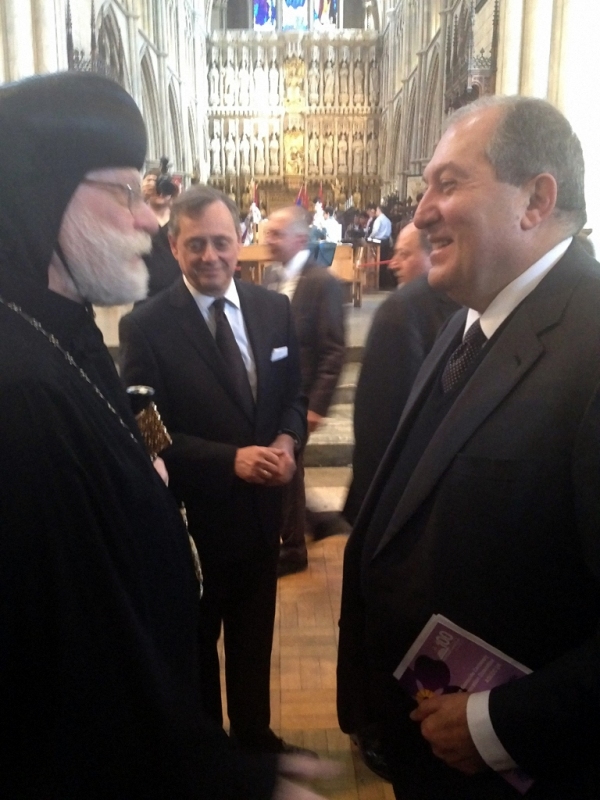
Among the events organised by the Armenian Genocide Centenary Commemoration Committee (AGCCC) in the United Kingdom, was a special Service in Southwark Cathedral on 18 April, which Abba Seraphim and Deacon Daniel attended. The Cathedral was very full and people arrived to the sound of the duduk, an ancient double-reed woodwind flute made of apricot wood. It is indigenous to Armenia and was proclaimed by UNESCO as a masterpiece of the Intangible Heritage of Humanity. The Dean of Southwark (The Very Rev’d Andrew Nunn) warmly welcomed those attending, recalling his fond memories of a recent pilgrimage to Armenia. A number of distinguished speakers were interspersed with cultural interludes of classical music (Handel and Bach) sung by Paula Sides (soprano) accompanied by Victoria Walker on the cello, who also performed a solo. Dr. Charles Tannock, MEP, a doughty champion of Armenia, spoke of the need to proclaim the fact of the Armenian Genocide as the way to healing the past and preventing such atrocities in the future. This theme was picked up and developed by His Eminence Archbishop Elisey of Sourozh (Russian Orthodox Church) who drew parallels with current events in the Middle East; Baroness Cox of Queensbury, who emphasised freedom, justice and truth and Professor William A. Schabus, a Genocide scholar, who warned of the dangers of denial. Towards the end, Dr. Armen Sarkissian, the Armenian Ambassador, spoke movingly of his childhood memories of conversations with his grandmother, a genocide survivor; and of the problems of keeping the ‘secret’ of the memory of the Genocide alive in the hostile environment of the Soviet Union. The service ended with a prayer and blessing offered by the Bishop of Southwark (The Right Rev’d Christopher Chessum).
Admitting past faults purifies nations
In a response to the news that the Turkish Republic has recalled its envoy to the Vatican in retaliation at Pope Francis referring to the Armenian Genocide, Abba Seraphim observed that this came as no surprise, as Turkey has a long history of denial.
Abba Seraphim applauded the Catholic Church, and other churches, who are sharing with the Armenian and Syriac Churches the commemoration of those tragic events, which saw a million and a half Armenians, as well as an estimated 300,000 Syriac Christians, driven to their deaths in a deliberately orchestrated attempt to remove them from their ancient homelands. They died as a consequence of the exertions suffered by the forced deportations of the infirm and elderly, as well as women and children, or by deliberately butchering those who might otherwise have defended themselves and their families.
The historical evidence for these terrible events is overwhelming, whilst Genocide denial, which attempts to distort the facts, questions the motivation of those remembering the victims, and even blames the victims themselves, is shameful and dishonest. Evidence has shown that those nations which can face up to their faults and have the humility to ask forgiveness for their collective sins, grow in moral stature, gain the esteem of their peers and are listened to with respect when they have something to say. Sadly Mr. Erdogan, the current President of Turkey, who, on coming to power, promised a moderate form of Islam, has proved himself authoritarian, increasingly intolerant of criticism, and a destabilising influence in the region as he steadily erodes the secular foundations of the Turkish Republic in favour of increasing Islamicisation.
The recent rise of the so-called Islamic Caliphate is predicated on the same genocidal theories which seeks the destruction of those who do not belong to the same ‘race’, which in this case is not simply a question of ethnicity, but an ever-narrowing interpretation of religious faith. Although a more recent manifestation, it is actually the heir of earlier evils which seek to destroy those whom the Creator brought into being.
Abba Seraphim reiterated that The British Orthodox Church stands in solidarity with our Armenian and Syriac brethren in commemorating these innocents who died in 1915 and will respond positively to the appeal by Their Holinesses the Supreme Catholicos of All Armenian, Patriarch Karekin II and Mar Ignatius Aphrem II, Patriarch of Antioch, that they should be remembered at Special Services of Prayer on 21 April.
Celebrating Holy Pascha
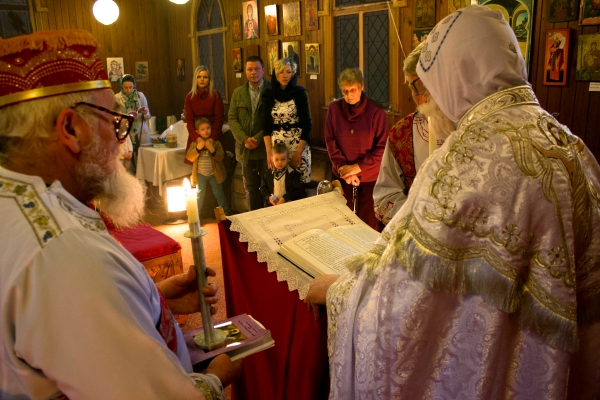
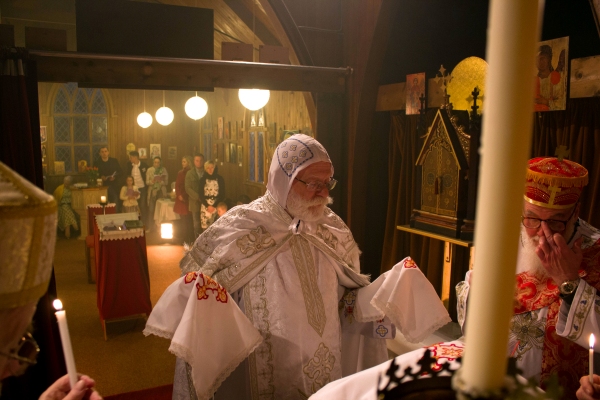
As in the past few years, Abba Seraphim presided at the Divine Liturgy for Pascha Eve at the Orthodox Church of St. Mary & St. Felix at Babingley in Norfolk, supported by Deacons Mark Saunders and Christopher Barnes, assisted by Subdeacons Roger-Kenneth Player and Trevor-James Maskery. The service was well attended by members of the congregation as well as local Orthodox families from a variety of nationalities. He asked them to keep in prayer Miss Dorothy Cossins, one of the founder members of the parish, who has always faithfully led the congregational singing for all services. She has been confined to home with mobility problems for the past few weeks and may need to move into care in the near future.
In his homily, Abba Seraphim spoke of the Orthodox understanding of Holy Week and the Resurrection Feast. He was pleased to see recently an article in The Guardian by Giles Fraser on the Western emphasis on our Lord’s passion and death, too often based on St. Anselm’s satisfaction theory of atonement and contrasting this with the Orthodox stress on Christ’s resurrection as freeing mankind from the imprisonment of death. He especially liked Fraser’s dismissal of the theological use of ‘economic’ metaphors, “Salvation is not some bloody cosmic accountancy. It’s a prison break.” Abba Seraphim highlighted St. Athanasios the Apostolic’s teachings on resurrection, “Through this union of the immortal Son of God with our human nature, all men were clothed with incorruption in the promise of the resurrection. For the solidarity of mankind is such that, by virtue of the Word’s indwelling in a single human body, the corruption which goes with death has lost its power over all.” He felt that the saint’s emphasis on the solidarity of mankind was hugely significant, as it correctly represents the nature of God as “the lover of mankind,” rather than a callous despot enslaved by a legalistic concept of His own justice, which detracts from the purpose of the cross as a supreme act of sacrificial love by our Lord.