Glastonbury Abbey – Influence and Legacy
Glastonbury Abbey – Influence and Legacy
A seminar at
Abbey House, Chilkwell Street, Glastonbury
Saturday 2 February 2013, 10 am – 4.30 pm.
The last few years have been and exciting time for Glastonbury archaeology and history, with the rediscovery and reinterpretation of material from historic excavations, new surveys of the Abbey grounds and architectural remains, and the exploration of new directions in historical understanding. Here a group of distinguished scholars at the cutting edge of Glastonbury research present an overview of the Abbey’s role in national life from its shadowy beginnings to the dawn of the Romantic era.
Registration: £15, payable by cheque to ‘British Orthodox Church’
BOC Secretariat, 10 HeathwoodGardens, Charlton, London, SE7 8EP
Programme:
Welcome and Introduction: H.E. Abba Seraphim, Metropolitan of Glastonbury.
New archaeological perspectives from the Historic Excavations of Glastonbury Abbey
Dr. Cheryl Green
The Glastonbury Abbey Excavation Archive Project is analysing, reinterpreting and making available the entire unpublished archaeological archive from the excavations conducted between 1908 and 1979. The paper outlines the historic excavations and the scope of this project before introducing some of the new discoveries and re-evaluations in relation to the mid- to late Saxon period.
***
Coffee
***
Glastonbury‘s Role in Late Saxon England
Prof. Michelle Brown
Michelle P. Brown, Professor Emerita, University of London, and former Curator of Illuminated Manuscripts at the British Library will speak about Glastonbury Abbey in the Anglo-Saxon period and its contribution towards the material culture of the reform movement of the tenth century.
***
Sandwich Lunch
***
IESVS: MARIA: The Late Medieval Cultus of the Virgin at Glastonbury.
Dr. Tim Hopkinson Ball
Through the story of its foundation, a church explained its existence and proclaimed its sanctity, both to itself and to the wider world. This paper explores the Virgin’s centrality to Glastonbury’s self identity in the high Middle Ages, especially in relation to lived spirituality at the abbey and the monastery’s putative founder, St Joseph of Arimathea.
***
Afternoon Tea
***
After Arimathea
Dr. Adam Stout
Joseph of Arimathea, lionised as a proto-Protestant in Elizabethan England, was consequently put firmly in his place by Catholics keen to assert the primacy of Rome. Adam Stout looks at how the political and religious changes of the next century or so saw this potent figure re-adopted by the Catholic cause amid Jacobite claims to speak for the whole nation
Summary: Paul Ashdown.
From Theophany to Nativity
Although the Oriental Orthodox churches in the United Kingdom share a common faith, they do not share a common calendar, so the Nativity Feast was celebrated on 25 December for the British, Indian and Syrian Orthodox, on 6 January for the Armenian Orthodox and 0n 7 January for the Coptic, Eritrean and Ethiopian Orthodox.
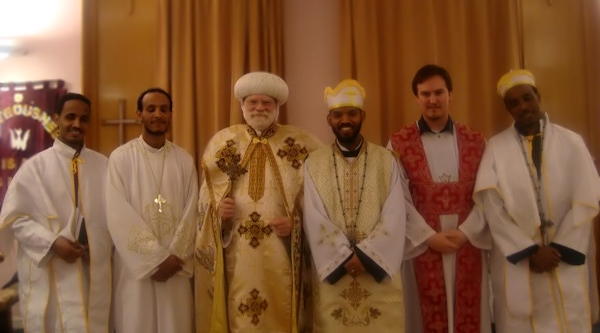
On 6 January Abba Seraphim presided at the Blessing of the Waters and Divine Liturgy at St. Mary & St. Felix Church at Babingley, Norfolk, where he preached on the meaning of the Holy Theophany, one of the seven great feasts of the Church. Having blessed all those present with the newly sanctified water, they afterwards took away bottles of the holy water for use in their homes. That same evening, Abba Seraphim presided at the Nativity Vigil of the canonical Eritrean Orthodox Church (recognising Patriarch Antonios) in London meeting in Archway, Highgate, where he was warmly welcomed by Father Shenouda Haile and his congregation. Also assisting in the sanctuary was Subdeacon Daniel Malyon from the British Orthodox Church. At the conclusion of the Divine Liturgy clergy and people sat together to enjoy a festive meal and Abba Seraphim blessed two birthday cakes as well as the traditional enjera, hambasha and wat.
Abba Seraphim’s Christmas Message, 2012
This year Abba Seraphim celebrated the Nativity Feast on Christmas Eve (24 December) at the Chatham Church. In his address Abba Seraphim spoke of the angelic proclamation of Peace on Earth, which he noted has always been elusive, “It seems almost alien to the natural condition of man and since the beginning of time, enmity and strife, whether domestic or between nations, has brought death, division and desolation in its wake.”
He especially addressed the current problems in the Middle East, “This year of grace we celebrate the Lord’s Nativity when the ancient biblical lands are more than unusually unsettled. That little town of Bethlehem and the Palestinian territories cry out for justice. We deplore the aggressive establishment of settlements by an intransigent Israeli state, but who can condone the charter of a corrupt and bloodthirsty Hamas which calls for the killing of Jews ? In Egypt we have seen the disappointment of a peaceful Revolution, which overthrew a corrupt regime, only to fall captive to narrow religious zealots who seek to promote their own interests rather than the common good. Blood has been shed and we may expect that more will follow, because in that divided society there can be no peace. Most of all we grieve for our brethren in Syria, torn apart by unspeakable savagery.”
With regard to the Syrian crisis, he felt that the current Coalition government, which prides itself on its promotion of civil liberties, equality and justice, both at home and abroad, has shown incredible short-sightedness in its response to the threat to Christian communities in the Middle-East. By supporting the so-called National Coalition for Syrian Revolutionary and Opposition Forces, which has been proved to be dominated by Islamist elements and financed by external regimes, our government has “effectively abandoned all possibilities to promote dialogue with both sides and has allied us to those who are destroying the significant Christian minority which has been there since apostolic times. Unlike Lord Carey, the former Archbishop of Canterbury, I cannot consider what he regards as Mr. Cameron’s “overtly Christian tone” in his Christmas address as being anything more than hollow words, when government policy doesn’t merely show casual indifference to the fate of our Christian brethren in Syria, but actively undermines them.”
Carol Service at Indian Orthodox Church, Brockley
On Saturday, 22nd December, Father Peter Farrington attended the Evening Prayers and Carol Service of the Indian Orthodox Church of St Gregorios, Brockley, London. He had been invited to give a homily to the congregation by Father Thomas John, and was very pleased indeed to be able to spend an evening in the company of fellow Orthodox Christians.
The evening began with the regular prayers of the Indian Orthodox tradition, offered in English, at which Father Peter assisted Father Thomas John. Then a programme of English carols, and songs in Malayalam had been organised, with a Nativity Play performed by the younger members of the congregation.
The range of talent in the congregation was most impressive and it seemed that there were three or four different choirs of great ability, which together with the enthusiastic performances of the children of the congregation made for a most delightful evening. At one point a choir of deacons sang some of the traditional Malayalam hymns of the Church and were joined by Father Thomas John and Father Mathew Abraham.
Father Peter spoke on the theme of Christ becoming man as the Prince of Peace, and particularly reflected on the prophecy of Isaiah and the angelic proclamation to the shepherds.
At the end of the evening Father Christmas distributed gifts to the excited children, and Father Peter was then fortunate to be able to share in some of the excellent and authentic Indian food which the hospitable community provided. This was a most enjoyable evening, and the opportunity to share in fellowship with the Indian Orthodox clergy and faithful was a most blessed beginning to the Nativity season.
Advent Carol Service at Bournemouth Church
The Church of Christ the Saviour, Bournemouth, Advent Carol Service took place this year on Sunday 9 December. Numbers were up on recent years and the enthusiastic congregation sang with joy and gusto. As the service is based on that anciently sung with the Magnificat in Vespers during Advent, the Magnificat was included, being chanted antiphonally. Further additions to the carols in the printed service were two beautiful solos by Diana Radu, Romanian Carols sung in her native language. The address was given by Subdeacon Antony-Paul Holland. He admitted that he had not always been “a great fan of carols” but had come to appreciate them for a number of reasons. There was the unity they offered “with our forbears”, those Christians of previous generations who had sung them before us and indeed who had composed them. Then there was their link with the scriptures, particularly “the prophecies of the coming of a Messiah such as those in the book of Isaiah, and the stories surrounding the Nativity in the New Testament.” Carols also helped us fulfil the numerous Biblical exhortations to sing and to join with the choirs of angels: “Our carolling is certainly an opportunity to join with this unceasing hymn of praise…”